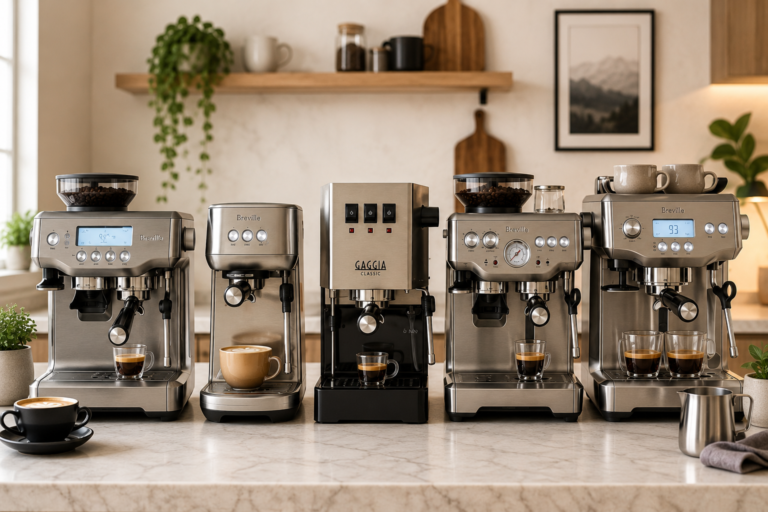

Best Minimalist Espresso Machines for Modern Kitchens (2026 Guide)
A great espresso machine doesn’t need to dominate your kitchen counter.
For many home coffee drinkers, the ideal setup is increasingly simple: a compact machine, clean lines, a few useful controls, and excellent espresso without turning the kitchen into a miniature coffee shop.
That’s where a good minimalist espresso machine comes in.
Minimalist doesn’t necessarily mean basic. Some of today’s most compact machines offer fast heating, precise temperature management, powerful steam wands, and enough control to make genuinely impressive espresso at home.
The difference is that they package those features into a cleaner, smaller design.
We looked for machines that balance four things particularly well: design, footprint, espresso performance, and everyday usability.
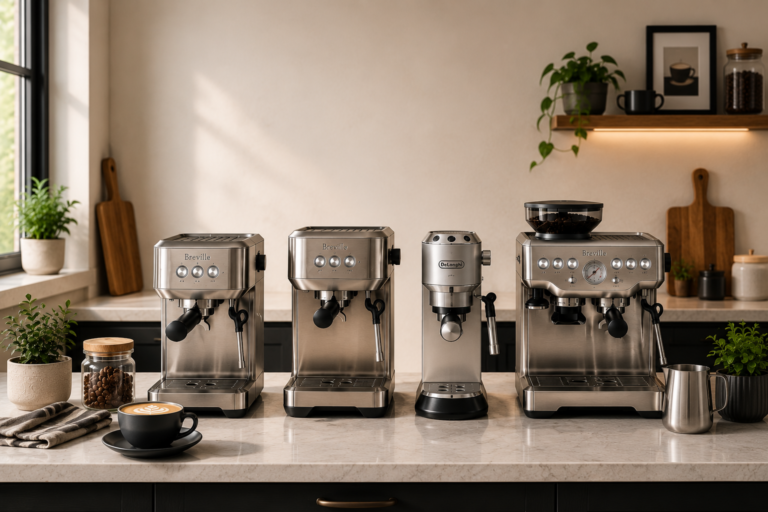
Whether you’re working with a tiny apartment kitchen or simply prefer a clutter-free countertop, these are the minimalist espresso machines we’d consider first in 2026.
Quick Picks
Best Overall – Breville Bambino
Compact, extremely fast to heat, straightforward to use, and capable of serious home espresso without taking over the counter.
Best Slim Design – De’Longhi Dedica
At roughly 15 cm wide, the Dedica is one of the easiest traditional espresso machines to fit into a narrow kitchen setup. De’Longhi itself describes the design as having a “minimalist chic” character.
Best for Design Lovers – Smeg ECF02
A strong choice when appearance matters almost as much as coffee. Its Italian-made design is compact, although its retro aesthetic is less strictly minimalist than the Bambino or Dedica.
Best for Beginners – Breville Bambino
Simple controls and a three-second heating system make it particularly approachable for someone moving beyond pod coffee.
Comparison Table
| Machine | Width | Heating System | Milk Frothing | Best For |
|---|---|---|---|---|
| Breville Bambino | 6.25 in | ThermoJet | Manual steam wand | Best overall |
| De’Longhi Dedica | 5.9 in / 15 cm | Thermoblock | Manual | Narrow counters |
| Smeg ECF02 | 5.9 in / 14.9 cm | Thermoblock | Manual steam wand | Design-focused kitchens |
Dimensions and specifications are based on manufacturer information and can vary slightly by regional version.
1. Breville Bambino – Best Minimalist Espresso Machine Overall
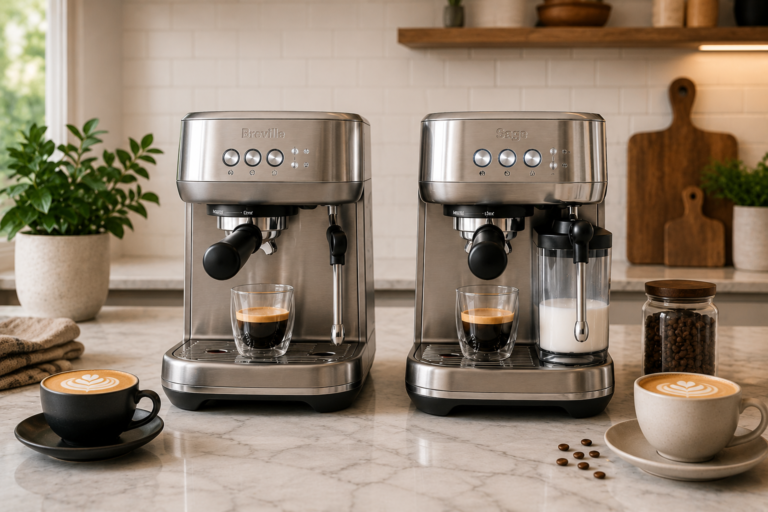
The Breville Bambino is almost exactly what we want from a modern minimalist espresso machine.
It doesn’t rely on a huge touchscreen or a complicated control panel. Instead, the front of the machine is remarkably simple, with controls for single and double shots, steam, and hot water.
More importantly, Breville hasn’t achieved the compact size by stripping away everything that makes an espresso machine useful.
The Bambino uses a 54 mm portafilter, low-pressure pre-infusion followed by 9-bar extraction, PID temperature control, and a manual steam wand capable of producing microfoam for milk drinks. Its ThermoJet heating system is ready in approximately three seconds.
Why It Works in a Minimalist Kitchen
The biggest advantage is its footprint.
The Bambino measures approximately 6.25 × 13.5 × 12 inches, giving it a narrow profile without making the machine feel like a novelty appliance.
That leaves considerably more counter space for the thing many espresso buyers forget about: the grinder.
Visually, the stainless-steel construction also works well with a wide variety of kitchen styles. It doesn’t demand attention in the same way as a brightly colored retro machine.
Espresso Performance
The Bambino is small, but it isn’t merely designed to look attractive on Instagram.
The combination of temperature control, pre-infusion, and 9-bar extraction gives you the basic tools needed to make proper espresso.
You’ll still need to learn grind size, dosing, and puck preparation, particularly if you’re using the single-wall baskets.
But that’s part of the appeal.
This is a machine a beginner can start with without necessarily needing to replace it as soon as their espresso skills improve.
Milk Drinks
The manual steam wand means there’s a learning curve.
That’s actually a benefit for anyone who wants to learn how to create proper microfoam rather than relying entirely on automatic frothing.
Once you develop the technique, cappuccinos, flat whites, and lattes are all realistic.
Who Should Buy It?
Choose the Bambino if you want:
- a genuinely compact machine;
- fast morning preparation;
- clean, understated design;
- real espresso capability;
- and room to improve your barista skills.
For most people looking specifically for a minimalist espresso machine, this would be our starting point.
2. De’Longhi Dedica – Best for Very Narrow Counters
If counter width is your biggest limitation, the De’Longhi Dedica deserves serious consideration.
At approximately 15 cm wide, it is exceptionally narrow. De’Longhi describes it as its slimmest espresso machine and specifically emphasizes its compact, minimalist styling.
That makes the Dedica particularly interesting for apartments, galley kitchens, studio flats, or coffee stations built into a small section of countertop.
Design
The Dedica is tall and narrow rather than short and wide.
That vertical design makes it visually unobtrusive when placed next to a grinder or against a kitchen wall.
Its stainless-steel construction also helps it look more premium than its footprint might suggest.
The illuminated controls are simple and don’t overwhelm the front of the machine.
Brewing
The Dedica uses a Thermoblock heating system and 15-bar pump. It can brew with ground coffee and compatible E.S.E. pods, depending on the basket being used.
It’s designed more around accessibility and convenience than enthusiast-level experimentation.
For someone who wants to make espresso every morning without turning coffee into a new hobby, that can be an advantage.
Milk Frothing
The adjustable Cappuccino System allows manual preparation of steamed or foamed milk.
It’s perfectly suitable for occasional cappuccinos and lattes.
Someone making multiple milk drinks every morning may eventually want a more powerful setup, but that’s not really the purpose of the Dedica.
Who Should Buy It?
The Dedica makes the most sense if:
- counter space is extremely limited;
- you want a slim, attractive appliance;
- you’re relatively new to espresso;
- and ease of use matters more than maximum control.
3. Smeg ECF02 – Best Minimalist Espresso Machine for Design Lovers
The Smeg ECF02 stretches our definition of “minimalist” slightly.
Its controls and footprint are relatively simple, but aesthetically this is very much a statement appliance.
Smeg’s distinctive 1950s-inspired styling makes the machine far more decorative than the understated Bambino.
Still, there’s a reason it belongs in this guide.
The machine itself is only about 149 mm wide, and Smeg specifically positions it as a compact, space-saving design.
Design
If your kitchen is carefully styled, the Smeg may be the most visually interesting machine here.
It’s available in multiple finishes, allowing it to become part of the kitchen design rather than simply another stainless-steel appliance.
The trade-off is obvious.
If by “minimalist” you mean completely neutral and visually invisible, choose the Bambino or Dedica.
If you mean small footprint + intentional design, the Smeg makes much more sense.
Espresso Performance
The ECF02 uses a Thermoblock heating system, 15-bar pump, 51 mm filter holder, adjustable coffee temperature, and manual steam system.
It can prepare single or double espresso and accommodate ground coffee or compatible paper pods.
Heating takes longer than the Bambino’s three-second system, but Smeg lists a start time of approximately 40 seconds.
That’s still perfectly reasonable for everyday home use.
Who Should Buy It?
Choose the Smeg if:
- aesthetics are a major buying factor;
- you want a small machine;
- your espresso routine is relatively straightforward;
- and you’re willing to pay partly for design.
What Makes an Espresso Machine Minimalist?
Minimalism isn’t simply about making an appliance smaller.
A genuinely good minimalist coffee setup usually combines several characteristics.
A Compact Footprint
Counter space is valuable.
A machine doesn’t necessarily need to be tiny, but it shouldn’t occupy more room than its functionality justifies.
Simple Controls
You don’t need twenty drink icons to make espresso.
For many people, a few clearly labeled buttons are actually easier and more pleasant to use.
Clean Design
Minimalist appliances tend to avoid excessive visual clutter.
Neutral colors, stainless steel, straightforward controls, and simple proportions make a machine easier to integrate into an existing kitchen.
Useful Features Rather Than More Features
This distinction matters.
A three-second heating system can genuinely improve your morning routine.
Ten obscure drink presets you never use probably won’t.
Good minimalist design is less about having fewer features and more about having the right features.
Minimalist vs. Compact Espresso Machines
These terms overlap, but they aren’t identical.
A compact espresso machine is simply physically small.
A minimalist espresso machine should ideally be both physically efficient and visually simple.
You can have a tiny machine covered in buttons, displays, and decorative elements. It’s compact, but it may not look minimalist.
Likewise, a beautiful modern espresso machine might have clean lines while still being enormous.
For this guide, we’re interested in the middle ground: machines that save space and contribute to a clean kitchen setup.
If space is your primary concern rather than aesthetics, read our Best Espresso Machines for Small Kitchens guide.
Manual vs. Automatic Espresso Machines in a Minimalist Kitchen
There’s an interesting trade-off here.
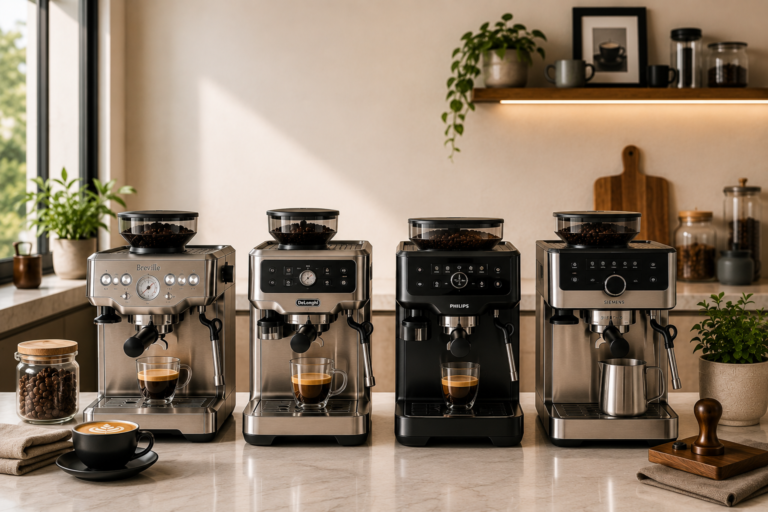
Fully automatic espresso machines are convenient, but they generally need to accommodate a grinder, brewing system, waste container, water tank, and often a milk system inside one body.
That can make them physically larger.
Compact manual or semi-automatic machines separate the grinder from the espresso machine.
Technically, that’s two appliances instead of one.
But it also allows you to create a much cleaner setup by choosing a compact grinder and positioning everything deliberately.
For coffee enthusiasts, the separate grinder also provides much more flexibility.
Does a Smaller Espresso Machine Make Worse Coffee?
No.
Physical size alone tells you surprisingly little about espresso quality.
The Bambino is a good example. Despite its compact dimensions, Breville includes PID temperature control, low-pressure pre-infusion, a 54 mm portafilter, and 9-bar extraction.
A larger machine may provide stronger steaming, greater thermal mass, larger boilers, or better performance when making several drinks consecutively.
Those benefits matter in certain households.
But if you’re making one or two drinks at a time, you don’t automatically need a large prosumer machine.
What to Look for Before Buying a Minimalist Espresso Machine
Width
Check actual measurements.
Product photography can make machines appear significantly smaller than they are.
And don’t forget the grinder.
A six-inch espresso machine next to an eight-inch grinder still requires fourteen inches of counter width before you account for space between them.
Depth
This is frequently overlooked.
A narrow machine can still extend surprisingly far toward the front edge of your counter.
Measure both width and depth before buying.
Water Tank Access
Ask yourself how you’ll refill it once the machine is under your cabinets.
A rear-loading tank may be perfectly convenient in an open kitchen but annoying underneath low cabinetry.
Heat-Up Time
Minimalist living tends to go hand-in-hand with convenience.
If you want espresso before work, a machine that heats quickly can have more everyday value than one with dozens of additional settings.
Steam Wand
Milk drinkers should pay attention here.
A small machine with poor steam performance may become frustrating if cappuccinos are your favorite drink.
Cleaning
Simple design should ideally extend to maintenance.
Removable drip trays, accessible water tanks, straightforward descaling, and easy-to-clean steam wands all make a difference over years of ownership.
The Grinder Matters More Than You Think
A beautiful espresso machine paired with a poor grinder is still a poor espresso setup.
This is particularly important when designing a minimalist coffee station.
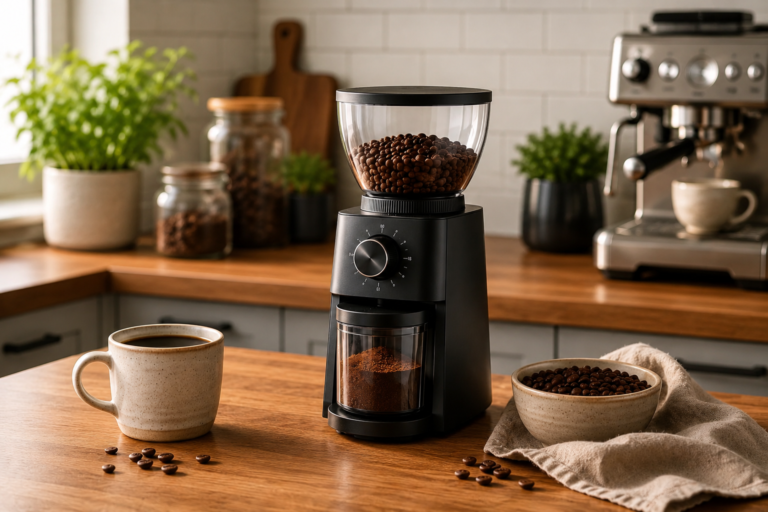
Instead of buying a huge machine with every feature imaginable, it can make more sense to pair a compact espresso machine with a capable burr grinder.
That gives you better control over grind size and makes it easier to adjust extraction.
If you’re trying to keep the complete setup affordable, see our Best Coffee Grinders Under $200 guide.
Best Minimalist Espresso Machine for Beginners
Our choice would be the Breville Bambino.
The interface is simple enough that a beginner isn’t confronted by dozens of settings, but the machine still leaves room to learn.
The three-second ThermoJet heating system also removes one of the annoyances associated with traditional espresso machines: waiting for them to warm up.
If you’re completely new to home espresso, we also recommend reading our Best Espresso Machines for Beginners guide.
How Much Should You Spend?
You don’t need to spend $1,000 to create an attractive home espresso setup.
In fact, the minimalist category is one of the places where spending intelligently matters more than spending heavily.
Your budget should include the grinder, accessories, and beans – not just the machine.
If you’re willing to invest more for improved espresso performance, compare your options in our Best Espresso Machines Under $1000 guide.
For a more budget-conscious setup, see Best Espresso Machines Under $500.
How to Build a Minimalist Home Coffee Setup
The easiest way to ruin a minimalist coffee station is to buy twenty accessories.
Start with the essentials.
A good setup needs an espresso machine, grinder, tamper, scale, milk pitcher if you make milk drinks, and somewhere to store beans.
That’s enough.
Keep accessories that you use every day within reach and store cleaning products elsewhere.
Matching materials can also make the setup feel visually calmer. Stainless steel, black, wood, or neutral ceramic accessories work particularly well because they don’t compete for attention.
Cable management matters too.
Two attractive appliances surrounded by tangled power cables don’t create a particularly minimalist result.
Finally, leave some empty counter space.
The goal isn’t to fit as much coffee equipment as possible into a small area.
It’s to create a coffee station that’s pleasant to use every morning.
Final Verdict
The best minimalist espresso machine isn’t necessarily the smallest or the most beautiful.
It needs to balance appearance with the thing that ultimately matters: making good coffee.
For most households, our first choice is the Breville Bambino. Its compact dimensions, extremely fast heating system, simple interface, temperature control, and capable steam wand create an unusually strong combination of performance and practicality.
If counter width is the overriding concern, the De’Longhi Dedica is particularly attractive at only around 15 cm wide.
And if your coffee machine is as much part of the room’s design as it is a kitchen appliance, the Smeg ECF02 offers a compact footprint with considerably more visual personality.
Ultimately, minimalist design isn’t about owning less for the sake of it.
It’s about choosing equipment that earns the space it occupies.
Frequently Asked Questions
What is the best minimalist espresso machine?
For most buyers, the Breville Bambino offers one of the strongest combinations of compact size, simple controls, fast heating, and genuine espresso capability.
What is the smallest espresso machine for a narrow kitchen?
The De’Longhi Dedica is particularly narrow at approximately 15 cm (5.9 inches) wide, making it well suited to limited counter space.
Are compact espresso machines good?
Yes. A compact machine can produce excellent espresso when it provides appropriate temperature management and pressure and is paired with a capable grinder.
Do I need a grinder with a minimalist espresso machine?
For machines using freshly ground coffee, yes. A good burr grinder is one of the most important parts of an espresso setup.
Is the Breville Bambino good for small kitchens?
Yes. Breville lists the Bambino at 6.25 inches wide and specifically markets it as having a compact countertop footprint.
Is a minimalist espresso machine good for beginners?
Often, yes. Machines with straightforward controls can be less intimidating while still teaching you the fundamentals of espresso preparation.
Should I buy a manual or automatic espresso machine?
Choose a semi-automatic machine if you want more control and don’t mind learning basic espresso technique. An automatic machine may suit you better if convenience is the overriding priority.